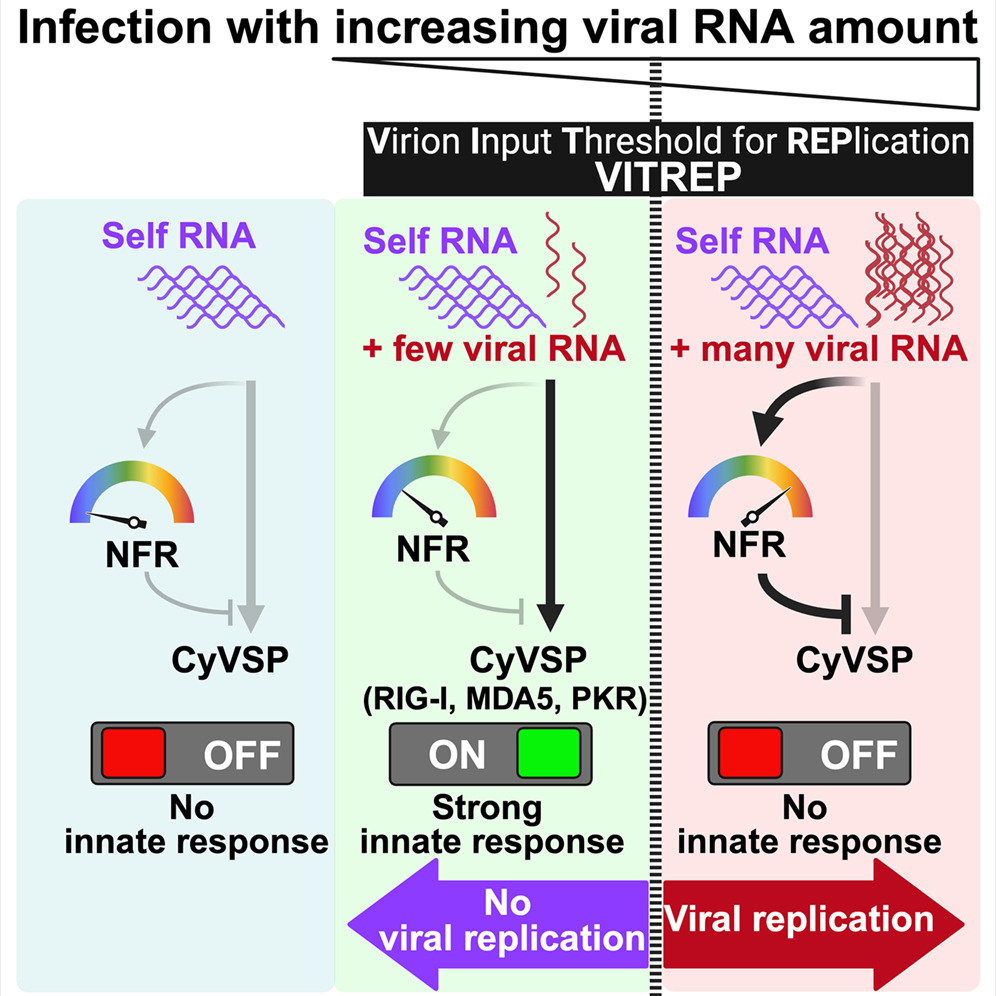
Innate sensor responses set a supra-unitary threshold for viral replication
A groundbreaking study co-authored by our faculty member Dr. Banu Bayyurt-Kocabaş has been published in the prestigious scientific journal Cell.
Titled "Innate sensor responses set a supra-unitary threshold for viral replication," the research provides a deep molecular dive into how cells coordinate their innate immune responses against viral infections. Utilizing mathematical modeling approaches, the study elegantly demonstrates the kinetics of how RNA sensors are controlled by kinases depending on the abundance of the viral genome.
Most notably, the research reveals for the first time that danger signals in the immune system are activated or deactivated not exclusively by non-self structural differences, but crucially by their quantity. This quantitative dependency establishes the supra-unitary threshold of viral load that ultimately dictates the success or failure of viral replication.
Article Citation:
Mukai, K., Jia, D., Panigrahi, M., ..., Bayyurt-Kocabaş, B., Altan-Bonnet, G., & Altan-Bonnet, N. (2027). Innate sensor responses set a supra-unitary threshold for viral replication. Cell 190, 1–18.